Bal-tec™ Home Kinematic Components Catalog 105-B
Kinematics Catalog #105-B
Free Viewer
Down load free SolidWorks eDrawing ™ viewer
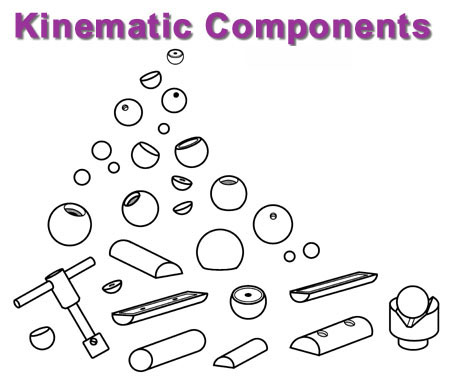
Kinematic Components—Graphical Summary Page
Click on component for more information
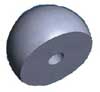
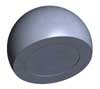
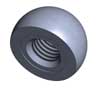
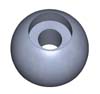
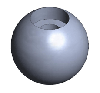
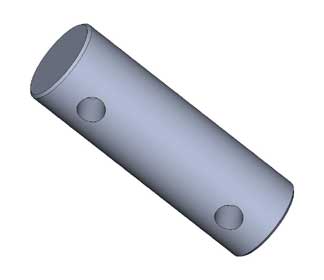
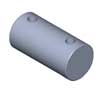
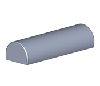
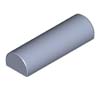
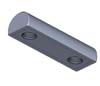
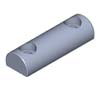
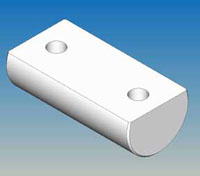
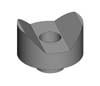
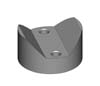
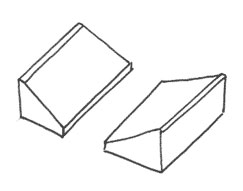
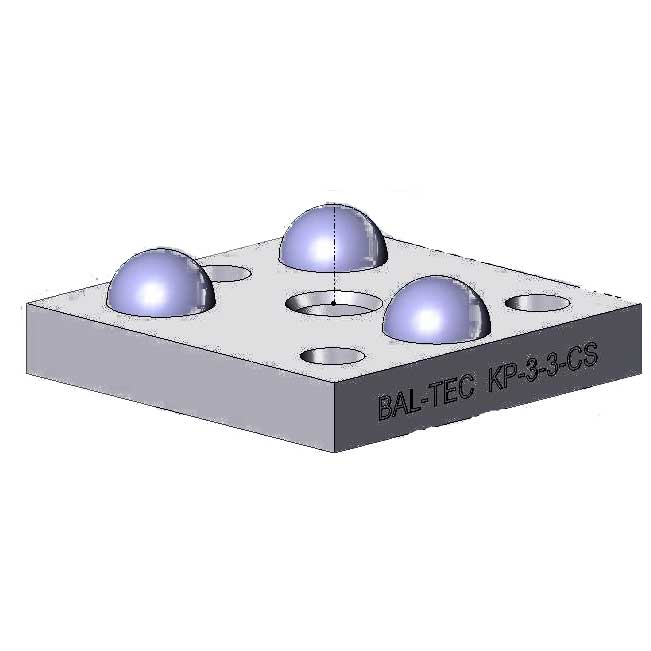
Introduction to Standardized Tooling Instrument and Kinematic Components For precise location in gaging, tooling and scientific instruments
The fundamental kinematic mount is a specialized method of coupling two elements in a mechanical system. One element is usually fixed to the frame of the apparatus, and the other is portable or movable. In a well designed mount, the portable element can be removed and replaced or indexed with nanometric repeatability. The concept of the kinematic mount is to eliminate any or all of the six degrees of freedom between the two elements of the system without using any strenuous clamping or over constraint. These degrees of freedom are usually defined as the three straight axis-"X" axis, "Y" axis,"Z" axis and the rotational axis of pitch, yaw and roll. A large number of variations on the fundamental Kinematic design have been developed. The "classical" design uses three spherical points of contact (balls) that are usually incorporated into one of these elements.
The second element incorporates a vee groove, a conical cup and a plane surface. Some of the factors that limit the ultimate accuracy of a kinematic system are the extreme difficulties of generating high quality conical cups and vee grooves. These problems can be solved using our kinematic components. By substituting two of our high-quality cylinders for the vee grooves and three of our high-quality spheres for the cone, you can achieve orders of magnitude improvement in repeatability. A careful choice of material is required in order to avoid the problem of fretting. Fretting may occur due to the high elastic loads caused by the small contact areas characteristic of most kinematic designs. We have developed our product line around an excellent fret-resistant material. It is a through-hardened, high-chrome, high-carbon stainless steel.
Another excellent choice of material is tungsten carbide. It is very fret-resistant and has an extremely high rigidity (i.e., Young's Modulus of Elasticity). Since it is much more expensive, it is not as widely used. Because there is little or no movement between the elements of a kinematic mount, the same material can be used for all components without the usual problems of wear and galling. Although we manufacture an extensive and expanding line of standard kinematic components, we will also custom-manufacture unique high quality components to your specifications. These may be made of materials with special heat or corrosive-resistant properties, or with different magnetic or electrical characteristics. They may be tailored to fit ideally into your products. These include prismatic Vee-Blocks with optical-quality metal surfaces, Kelvin trihedral cups with optical-quality metal facets and cathedral or Gothic arch-vees with optical quality radii.
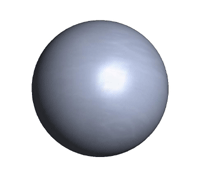
Complete Ball as a Kinematic Component
| Downloads | ||
|---|---|---|
| Solidworks | IGES | |
 |
|
N/A |
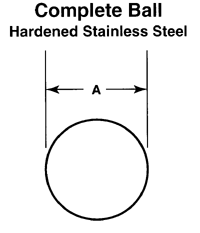
A complete ball should be used whenever possible. It is the lowest cost and highest-quality product. In many applications, they can be staked or press-fit into place. In low stress applications, the ball can be glued into the assembly. When gluing a ball into an assembly, the cleanliness of the surfaces is of the greatest importance.
| Part No. | A-Diameter ±.0001" | Sphericity |
|---|---|---|
| 187-B | .1875" 4.763 mm |
.000010" .000254 mm |
| 250-B | .250" 6.35 mm |
.000010" .000254 mm |
| 312-B | .3125" 7.9375 mm |
.000010" 000254 mm |
| 375-B | .3750" 9.525 mm |
.000010" .000254 mm |
| 500-B | .500" 12.700 mm |
.000010" .000254 mm |
| 625-B | .625" 15.87 mm |
.000010" .000254 mm |
| 750-B | .750" 19.05 mm |
.000010" .000254 mm |
| 100-B | 1.00" 25.4 mm |
.000010" .000254 mm |